Data Center Cooling Types
Air Cooling

Air cooling is a data center cooling method that uses fans and air conditioning units (often within the computer room in the form of CRAHs) to circulate cool air between IT racks, expelling the hot air from computing equipment.
Considered the most traditional cooling method, air cooling is used by approximately 80% of data centers. It is most suitable for smaller data centers, because it is sufficient for smaller heat loads while being cost-effective and easy to implement on a small scale. However, for larger data centers with a more significant heat load, air cooling is insufficient and must be supplemented or hybridized with other methods like liquid cooling.
In cooler climates, some data centers can reduce energy consumption by circulating ambient cool air to cool equipment (known as free cooling), bypassing the energy-intensive process of conditioning the air.
On average, air-cooled data centers have a relatively inefficient power usage effectiveness of 1.70, but a near-zero water usage since they do not directly use water for cooling, not considering their indirect water use.
Liquid Cooling
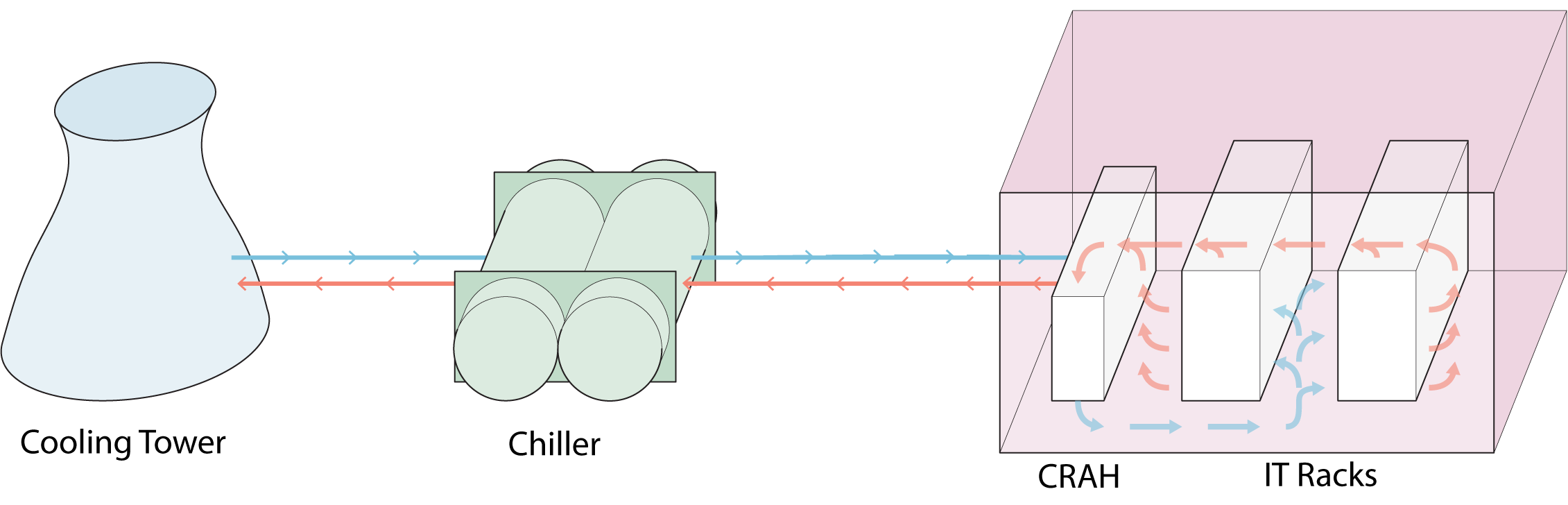
Liquid cooling is a data center cooling method that uses liquid coolants (often water) to absorb heat from computing equipment. This method can appear in a variety of ways.
One type of liquid cooling, illustrated above, is called evaporative cooling, and uses cooling towers to draw hot air through water-saturated media, with the water's evaporation absorbing heat from the air. The cooling tower is used to cool the chiller's condenser water, allowing the chiller to circulate colder water to the computer room, where it is either circulated directly through the IT racks or, in a hybridized system using air cooling, supplied to the CRAH. Another variant of liquid cooling is immersion cooling, in which servers and IT equipment are directly submerged in a dielectric fluid coolant to remove heat.
In terms of liquid supply, liquid cooling can use either a closed-loop or an open-loop system. Closed-loop systems are more expensive to implement, but recirculate the coolant to reduce water use and prevent contamination. Open-loop systems are more cost-effective, but use water only once before disposing of are more water-intensive and involve a higher risk of environmental contamination.
Liquid cooling (excluding the immersion cooling variant) is used by about 16% of data centers. Compared to air cooling, liquid cooling is more energy-efficient and is equipped to handle larger, higher-density servers.
On average, liquid-cooled data centers (excluding immersion cooling) have a power usage effectiveness of 1.38, and a relatively inefficient water usage effectiveness of 1.90, not considering their indirect water use.
Depending on their location, some data centers can take advantage of existing water features to reduce energy consumption. For example, in Marseille, France, Interxion uses a form of liquid-based free cooling, sourcing water from a tunnel that carries flowing water at a natural, consistent temperature of 15C. Although the water still requires some filtration, the facilities bypass the need for extensive cooling processes, improving its power usage effectiveness to 1.11.
Immersion Cooling
![immersion diag [Converted].png](https://hydraulogistics.at/uploads/images/gallery/2025-09/scaled-1680-/immersion-diag-converted.png)
Immersion cooling is a data center cooling method where IT equipment is directly submerged in a thermally conductive but electrically non-conductive fluid (known as dielectric fluid). Heat generated by the servers is absorbed by the fluid and then transferred to external systems through either single-phase or two-phase processes.
Although still an emerging technology, immersion cooling currently accounts for only about 4–6% of data centers globally. It is most suitable for large-scale or high-density deployments because of its ability to handle much higher thermal loads than traditional methods.
Unlike air cooling, immersion cooling eliminates the need for server fans and reduces the reliance on CRAH units, lowering both power consumption and noise. It also has the potential to significantly reduce water consumption compared to conventional liquid or evaporative cooling, depending on the external heat rejection system used.
On average, immersion cooling allows for some of the most efficient operations in the industry, with reported power usage effectiveness as low as 1.03, while also lowering total operational costs by reducing the energy needed to move and condition air.
Free Cooling
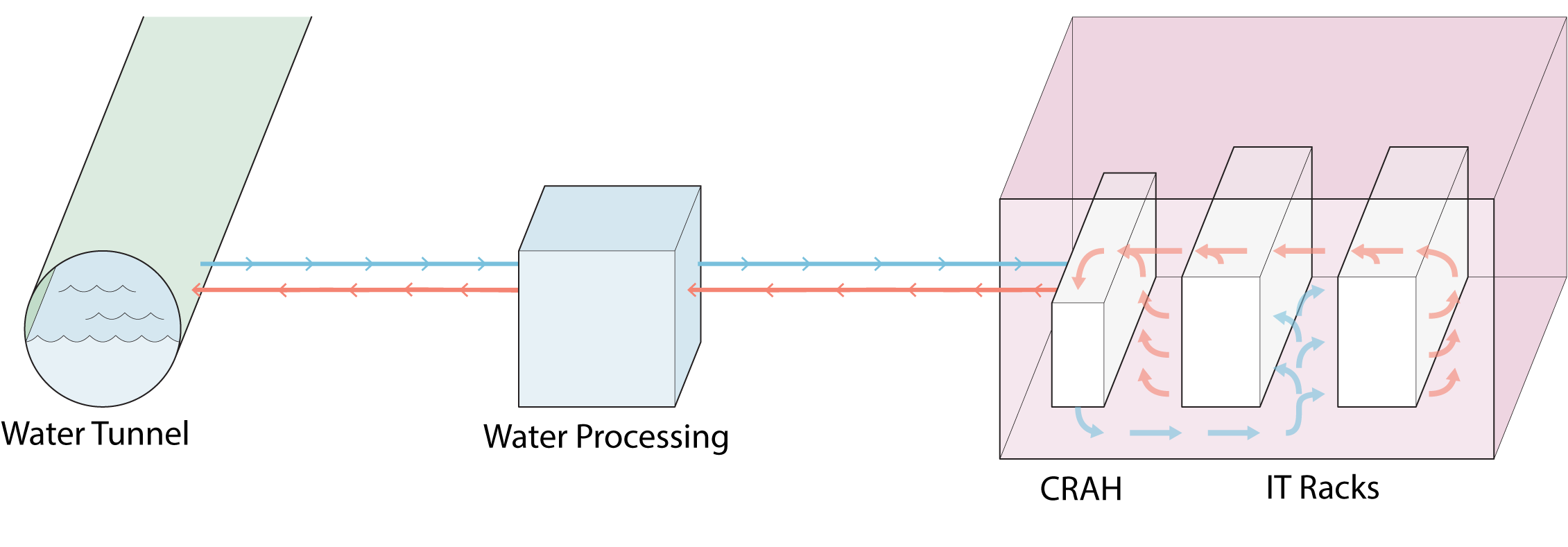 Free cooling is a data center cooling method that takes advantage of local climate or geologic features to reduce reliance on mechanical refrigeration. Some data centers located in cool climates circulate ambient cool air to cool equipment, saving energy and water by eliminating the process of conditioning the air. Other data centers located near naturally cold water features use this water for liquid cooling, saving energy by eliminating the process of chilling the water.
For example, in Marseille, France, Interxion sources water from a tunnel that carries flowing water at a natural, consistent temperature of 15C. Although the water still requires some filtration, the facilities bypass the need for extensive cooling processes, improving its power usage effectiveness to 1.11 compared to the average PUE of 1.38 for liquid cooling.