# Chilled Infrastructures
How are data centers cooled, and how do these cooling systems affect their surrounding environment?
# Data Center Cooling Types
# Air Cooling
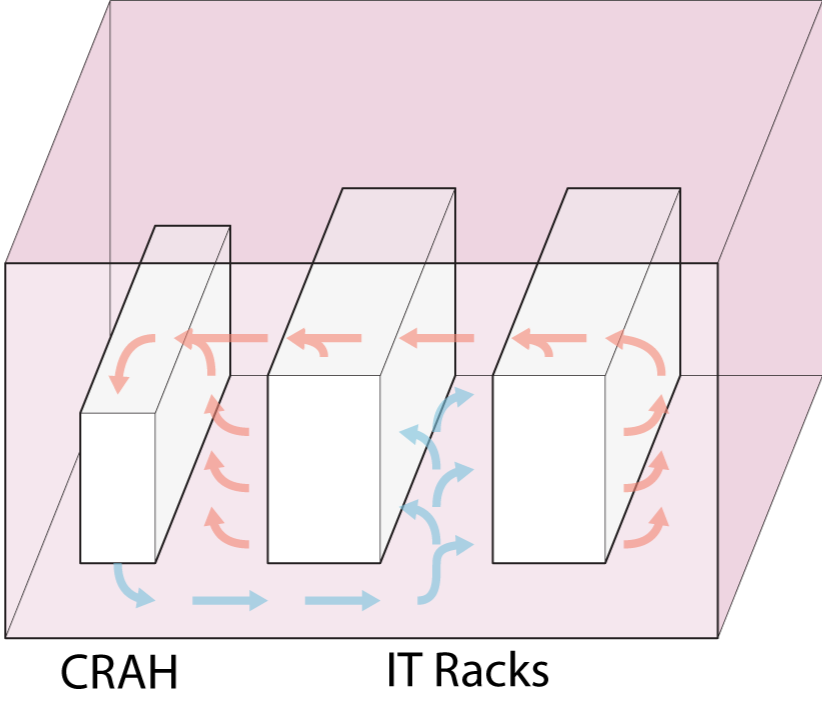Air cooling is a data center cooling method that uses fans and air conditioning units (often within the computer room in the form of [CRAH](https://hydraulogistics.at/link/16#bkmrk-crah)s) to circulate cool air between IT racks, expelling the hot air from computing equipment.
Considered the most traditional cooling method, air cooling is used by approximately 80% of data centers. It is most suitable for smaller data centers, because it is sufficient for smaller heat loads while being cost-effective and easy to implement on a small scale. However, for larger data centers with a more significant heat load, air cooling is insufficient and must be supplemented or hybridized with other methods like [liquid cooling](https://hydraulogistics.at/books/chilled-infrastructures/page/liquid-cooling "Liquid Cooling").
In cooler climates, some data centers can reduce energy consumption by circulating ambient cool air to cool equipment (known as [free cooling](https://hydraulogistics.at/books/chilled-infrastructures/page/free-cooling "Free Cooling")), bypassing the energy-intensive process of conditioning the air.
On average, air-cooled data centers have a relatively inefficient [power usage effectiveness](https://hydraulogistics.at/link/16#bkmrk-pue) of [1.70](https://hydraulogistics.at/books/chilled-infrastructures/page/comparing-impacts-by-cooling-type "Comparing Impacts by Cooling Type"), but a near-zero water usage since they do not directly use water for cooling, not considering their [indirect water use](https://hydraulogistics.at/link/16#bkmrk-indirect-water-use).
# Liquid Cooling
[](https://hydraulogistics.at/uploads/images/gallery/2025-09/scaled-1680-/liquid-cooling.png)
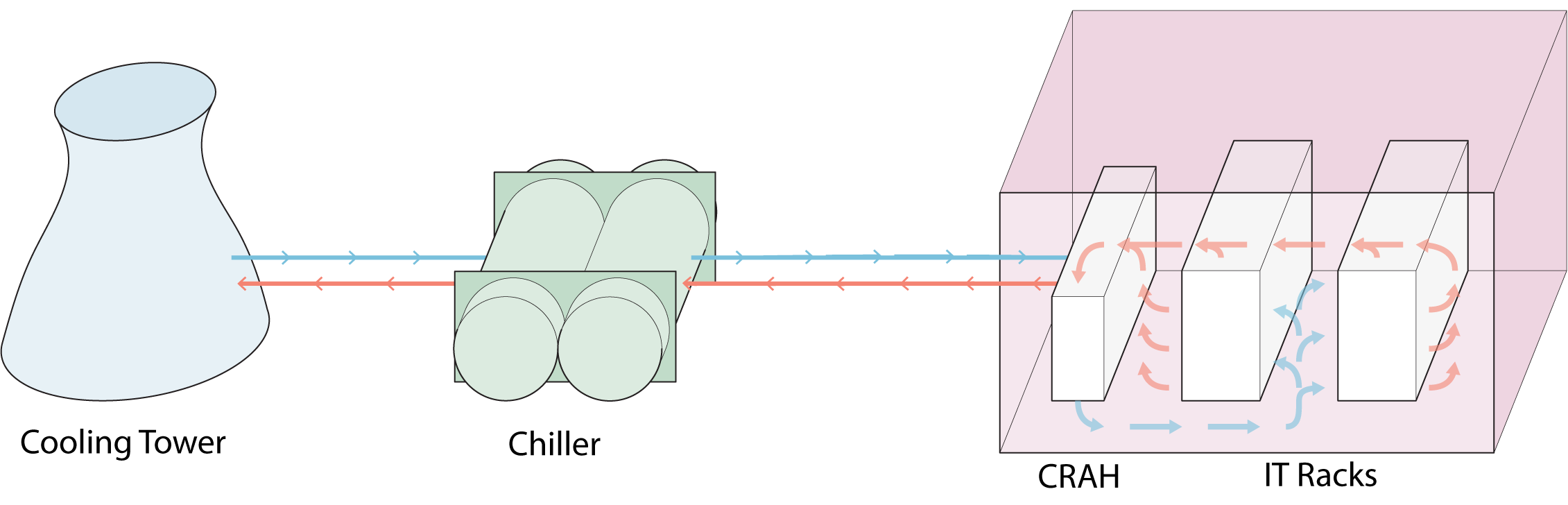
Liquid cooling is a data center cooling method that uses liquid coolants (often water) to absorb heat from computing equipment. This method can appear in a variety of ways.
One type of liquid cooling, illustrated above, is called [evaporative cooling](https://hydraulogistics.at/link/16#bkmrk-evaporative-cooling), and uses [cooling towers](https://hydraulogistics.at/link/16#bkmrk-cooling-tower) to draw hot air through water-saturated media, with the water's evaporation absorbing heat from the air. The cooling tower is used to cool the [chiller](https://hydraulogistics.at/link/16#bkmrk-chiller)'s condenser water, allowing the chiller to circulate colder water to the computer room, where it is either circulated directly through the IT racks or, in a hybridized system using [air cooling](https://hydraulogistics.at/books/chilled-infrastructures/page/air-cooling "Air Cooling"), supplied to the [CRAH](https://hydraulogistics.at/link/16#bkmrk-crah). Another variant of liquid cooling is [immersion cooling](https://hydraulogistics.at/books/chilled-infrastructures/page/immersion-cooling "Immersion Cooling"), in which servers and IT equipment are directly submerged in a [dielectric fluid](https://hydraulogistics.at/link/16#bkmrk-dielectric-fluid) coolant to remove heat.
In terms of liquid supply, liquid cooling can use either a [closed-loop](https://hydraulogistics.at/link/16#bkmrk-closed-loop-system) or an [open-loop](https://hydraulogistics.at/link/16#bkmrk-open-loop-system) system. Closed-loop systems are more expensive to implement, but recirculate the coolant to reduce water use and prevent contamination. Open-loop systems are more cost-effective, but use water only once before disposing of are more water-intensive and involve a higher risk of environmental contamination.
Liquid cooling (excluding the immersion cooling variant) is used by about 16% of data centers. Compared to air cooling, liquid cooling is more energy-efficient and is equipped to handle larger, higher-density servers.
On average, liquid-cooled data centers (excluding immersion cooling) have a [power usage effectiveness](https://hydraulogistics.at/link/16#bkmrk-pue) of [1.38](https://hydraulogistics.at/books/chilled-infrastructures/page/comparing-impacts-by-cooling-type "Comparing Impacts by Cooling Type"), and a relatively inefficient [water usage effectiveness](https://hydraulogistics.at/link/16#bkmrk-wue) of [1.90](https://hydraulogistics.at/books/chilled-infrastructures/page/comparing-impacts-by-cooling-type "Comparing Impacts by Cooling Type"), not considering their [indirect water use](https://hydraulogistics.at/link/16#bkmrk-indirect-water-use).
Depending on their location, some data centers can take advantage of existing water features to reduce energy consumption. For example, in [Marseille, France](https://hydraulogistics.at/books/chilled-infrastructures/page/marseille-france "Marseille, France"), Interxion uses a form of liquid-based [free cooling](https://hydraulogistics.at/books/chilled-infrastructures/page/free-cooling "Free Cooling"), sourcing water from a tunnel that carries flowing water at a natural, consistent temperature of 15C. Although the water still requires some filtration, the facilities bypass the need for extensive cooling processes, improving its [power usage effectiveness](https://hydraulogistics.at/link/16#bkmrk-pue) to [1.11](https://hydraulogistics.at/books/chilled-infrastructures/page/comparing-impacts-by-cooling-type "Comparing Impacts by Cooling Type").
# Immersion Cooling
[![immersion diag [Converted].png](https://hydraulogistics.at/uploads/images/gallery/2025-09/scaled-1680-/immersion-diag-converted.png)](https://hydraulogistics.at/uploads/images/gallery/2025-09/scaled-1680-/immersion-diag-converted.png)
Immersion cooling is a data center cooling method where IT equipment is directly submerged in a thermally conductive but electrically non-conductive fluid (known as [dielectric fluid](https://hydraulogistics.at/link/16#bkmrk-dielectric-fluid)). Heat generated by the servers is absorbed by the fluid and then transferred to external systems through either [single-phase](https://hydraulogistics.at/link/16#bkmrk-single-phase-immersi) or [two-phase](https://hydraulogistics.at/link/16#bkmrk-two-phase-immersion-) processes.
Although still an emerging technology, immersion cooling currently accounts for only about 4–6% of data centers globally. It is most suitable for large-scale or high-density deployments because of its ability to handle much higher thermal loads than traditional methods.
Unlike [air cooling](https://hydraulogistics.at/books/chilled-infrastructures/page/air-cooling "Air Cooling"), immersion cooling eliminates the need for server fans and reduces the reliance on [CRAH ](https://hydraulogistics.at/link/16#bkmrk-crah)units, lowering both power consumption and noise. It also has the potential to significantly reduce water consumption compared to conventional liquid or evaporative cooling, depending on the external heat rejection system used.
On average, immersion cooling allows for some of the most efficient operations in the industry, with reported [power usage effectiveness](https://hydraulogistics.at/link/16#bkmrk-pue) as low as [1.03](https://hydraulogistics.at/link/24#bkmrk-page-title), while also lowering total operational costs by reducing the energy needed to move and condition air.
# Free Cooling
[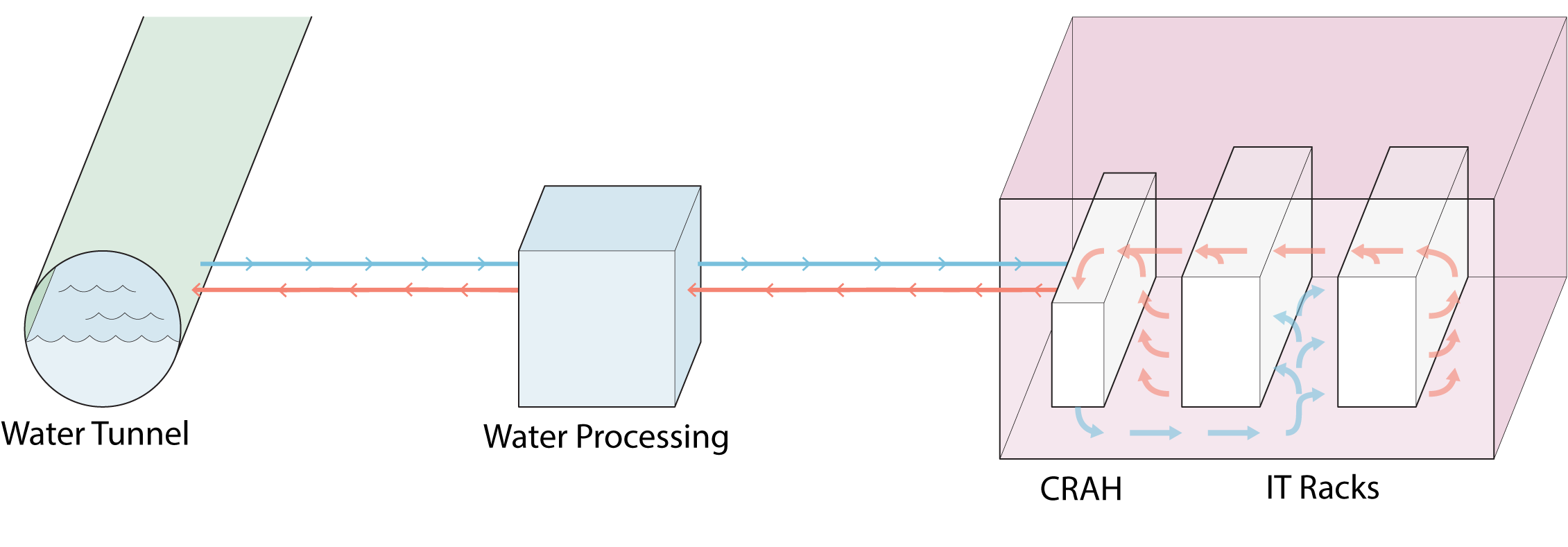](https://hydraulogistics.at/uploads/images/gallery/2025-09/scaled-1680-/marseille-cooling.png)Free cooling is a data center cooling method that takes advantage of local climate or geologic features to reduce reliance on mechanical refrigeration. Some data centers located in cool climates circulate ambient cool air to cool equipment, saving energy and water by eliminating the process of conditioning the air. Other data centers located near naturally cold water features use this water for [liquid cooling](https://hydraulogistics.at/books/chilled-infrastructures/page/liquid-cooling "Liquid Cooling"), saving energy by eliminating the process of chilling the water.
For example, in [Marseille, France](https://hydraulogistics.at/books/chilled-infrastructures/page/marseille-france "Marseille, France"), Interxion sources water from a tunnel that carries flowing water at a natural, consistent temperature of 15C. Although the water still requires some filtration, the facilities bypass the need for extensive cooling processes, improving its [power usage effectiveness](https://hydraulogistics.at/link/16#bkmrk-pue) to [1.11](https://hydraulogistics.at/books/chilled-infrastructures/page/comparing-impacts-by-cooling-type "Comparing Impacts by Cooling Type") compared to the average PUE of [1.38](https://hydraulogistics.at/books/chilled-infrastructures/page/comparing-impacts-by-cooling-type "Comparing Impacts by Cooling Type") for liquid cooling.
# Impacts of Cooling
# Visualizing Water Consumption: US Data Centers
[](https://hydraulogistics.at/uploads/images/gallery/2025-09/scaled-1680-/ngDmap-try-fri.jpg)
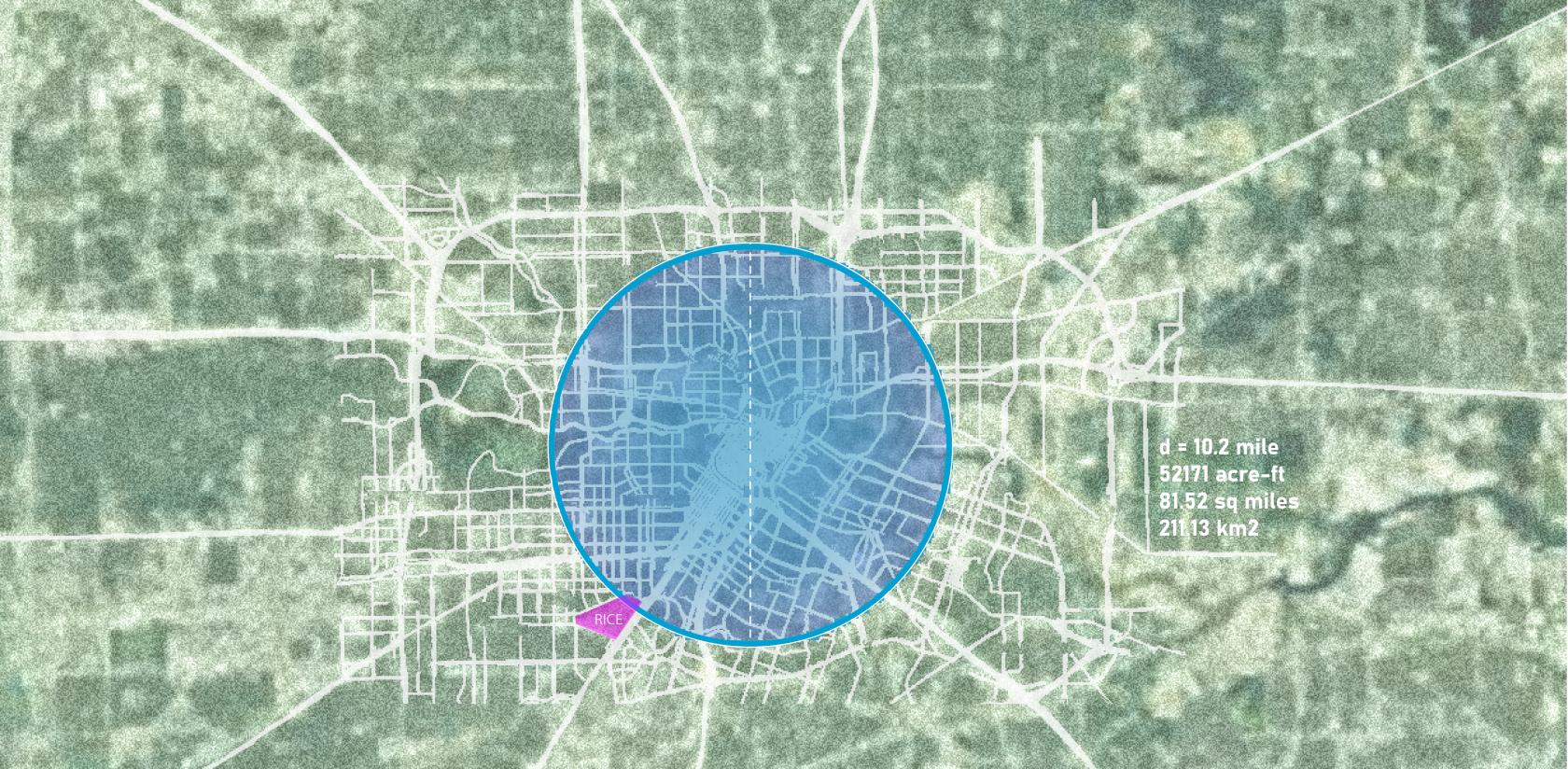
In 2023 alone, US data centers consumed an estimated **17 billion gallons** of water. That's 52,171 [acre-feet](https://hydraulogistics.at/link/16#bkmrk-acre-foot) of water, enough to cover a **10.2-mile-wide circle** in a foot of water!
[](https://hydraulogistics.at/uploads/images/gallery/2025-09/scaled-1680-/5bayou-map.png)
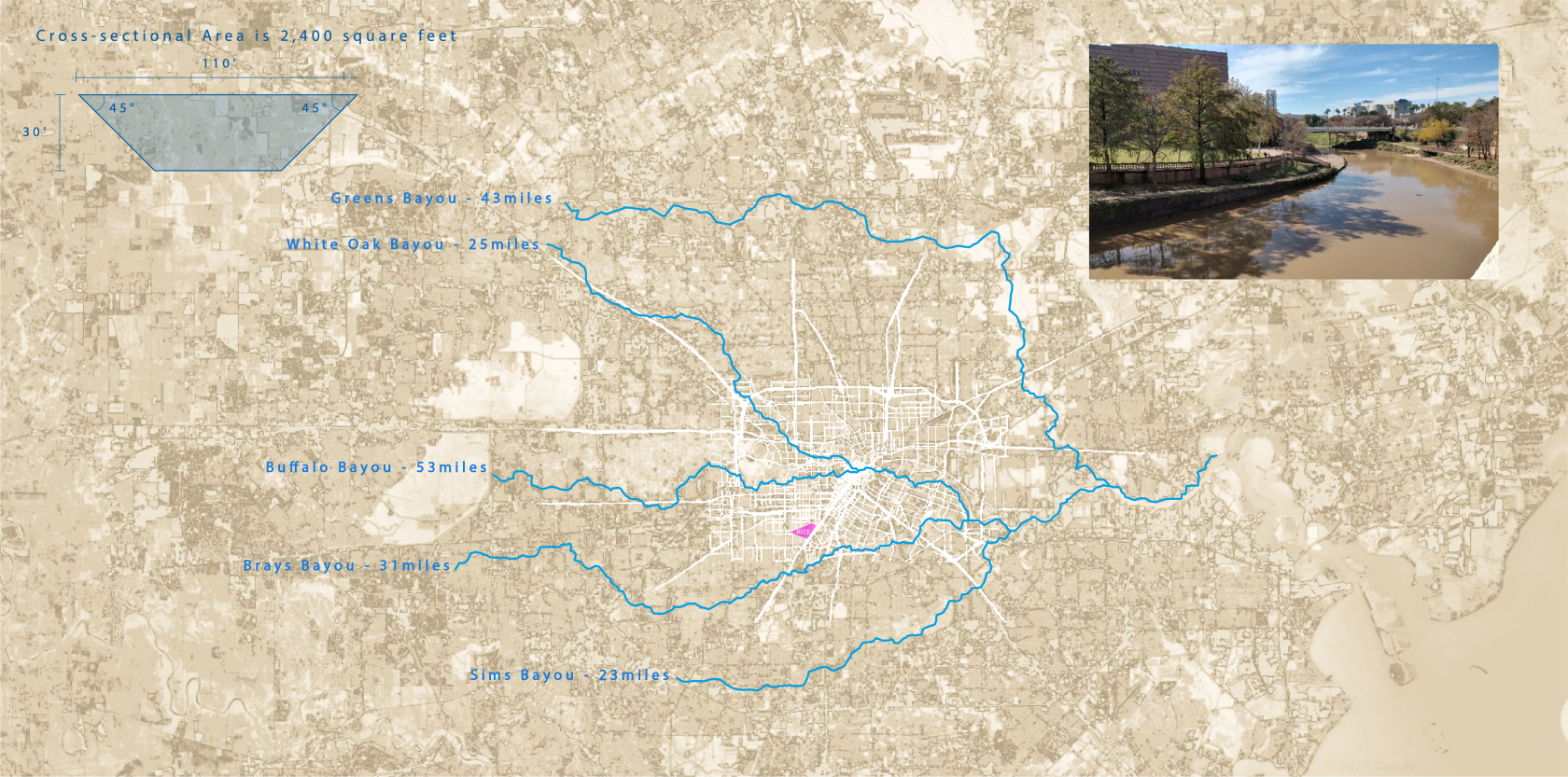
Estimating the average cross-sectional area of a bayou channel at 2,400 square feet, **the 17 billion gallons of water consumed by US data centers in 2023 could fill 179 miles of bayou channels**, which is longer than the combined length of all of Houston's 5 major bayous (175 miles).
# Visualizing Water Consumption: Hyperscale Data Centers
[![anderson submerged 2 [Converted].png](https://hydraulogistics.at/uploads/images/gallery/2025-09/scaled-1680-/anderson-submerged-2-converted.png)](https://hydraulogistics.at/uploads/images/gallery/2025-09/scaled-1680-/anderson-submerged-2-converted.png)
[![rice submerged [Converted].png](https://hydraulogistics.at/uploads/images/gallery/2025-09/scaled-1680-/rice-submerged-converted.png)](https://hydraulogistics.at/uploads/images/gallery/2025-09/scaled-1680-/rice-submerged-converted.png)
Just **one hyperscale data center** uses about **200 million gallons of water per year**; enough water to fill the entire area enclosed by Rice University's inner loop to a depth of **13.85 feet**!
# Visualizing Water Consumption: Non-potable vs Potable
[](https://hydraulogistics.at/uploads/images/gallery/2025-09/scaled-1680-/circle-map.png)
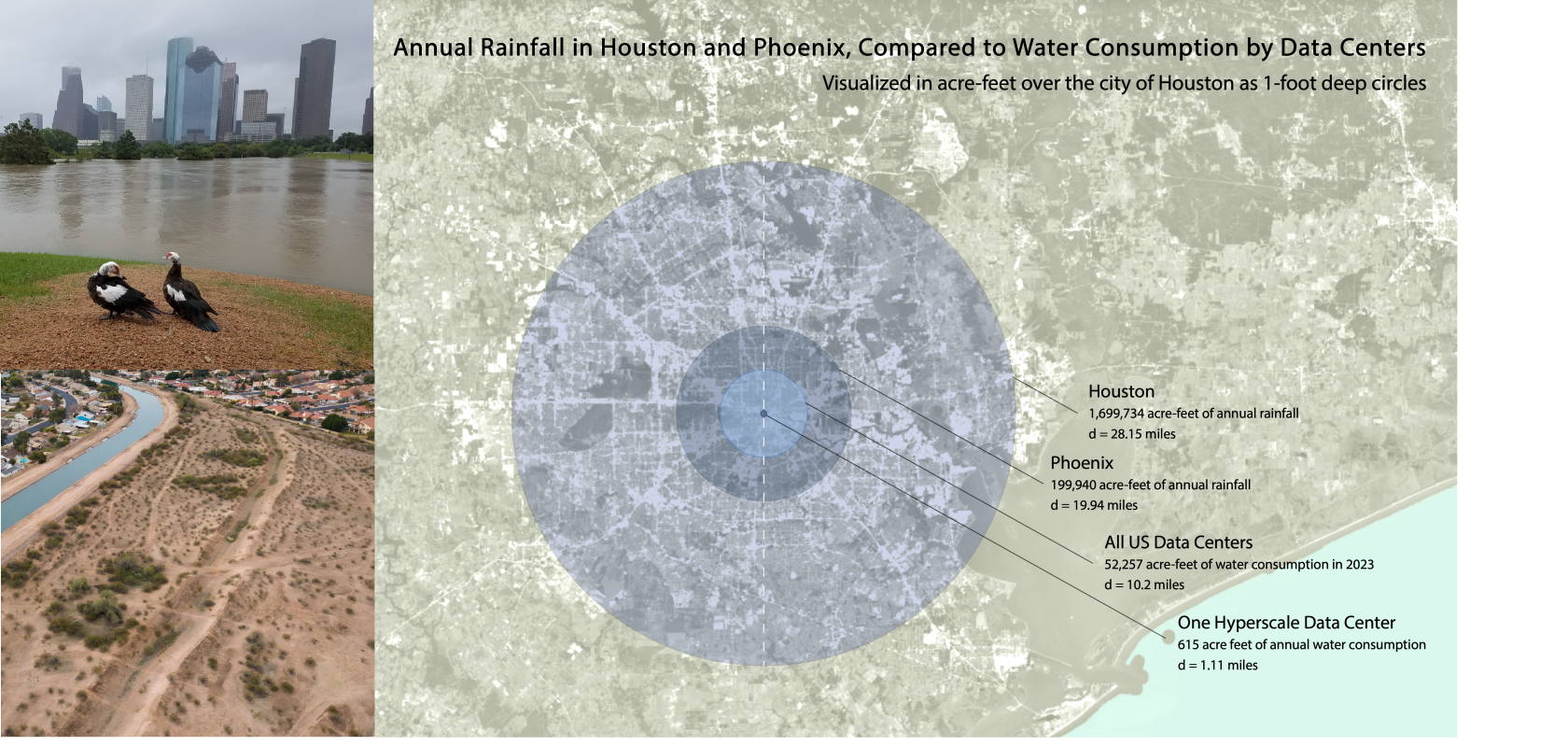
This figure highlights the contrast between city rainfall and the scale of water consumption by data centers. Houston, with nearly 1.7 million [acre-feet](https://hydraulogistics.at/link/16#bkmrk-acre-foot) of annual rainfall, receives more than eight times Phoenix’s 200,000 acre-feet. This is a reflection of their climates, the former being [water-abundant](https://hydraulogistics.at/books/chilled-infrastructures/page/data-centers-in-coastal-areas "Data Centers in Coastal Areas") and the latter [drought-prone](https://hydraulogistics.at/books/chilled-infrastructures/page/data-centers-in-hot-dry-climates "Data Centers in Hot, Dry Climates"). When placed against these baselines, the water use of data centers appears smaller but remains very significant. In 2023, all U.S. data centers together consumed about 52,257 acre-feet of water—roughly a quarter of Phoenix’s annual rainfall. A single [hyperscale data center](https://hydraulogistics.at/link/16#bkmrk-hyperscale-data-cent) alone uses around 615 acre-feet annually, visualized here as just over a 1-mile-wide circle.
Although total rainfall, even in drought-prone Phoenix, far exceeds the water consumption of data centers, the central issue is the type of water they use. Most data centers rely on potable, drinking-grade water rather than reclaimed or non-potable sources. For instance, Google reported that in 2023 only about 22% of its water withdrawals for data centers came from reclaimed or non-potable sources, meaning that the remaining 78% was potable water. This reliance means that data centers compete directly with local communities for limited supplies of drinking water.
The reason reclaimed water is not more widely used lies in both technical and regulatory challenges. Non-potable water can accelerate corrosion, scaling, and microbiological growth in cooling systems, which in turn shortens equipment life and increases maintenance. To manage this, engineers must regularly assess water quality, including pH, conductivity, total dissolved solids, chlorides, silicon, hardness, alkalinity, and microbial counts. They often need to work with local utilities to request additional treatment or to identify alternative sources that can reduce risks to equipment performance.
There are also practical barriers, such as using reclaimed water requires more frequent cleaning and specialized equipment to handle impurities. Permitting is often complex, and compatibility with treatment plants is not always guaranteed. Many areas also lack infrastructure such as purple pipe systems, which are designed to deliver non-potable water for industrial use. On top of that, advanced treatments such as ultrafiltration, ozonation, or reverse osmosis can make reclaimed water safer for cooling, but increase costs and add operational complexity.
Despite these challenges, some companies have made progress. Microsoft’s facility in Quincy, Washington, uses untreated irrigation canal water for cooling, relying on only about 5% potable water. To deal with mineral buildup and wastewater issues, the company and the city developed the Quincy Water Reuse Utility, a closed-loop treatment system that recycles cooling water and saves an estimated 138 million gallons of potable groundwater annually. Similarly, Amazon has also expanded its use of recycled wastewater, treating and reusing it by developing a plant-based treatment method using sphagnum moss to reduce chemical use while improving water quality. Moreover, Digital Realty in Singapore has deployed an electrolytic descaling system that prevents impurities from accumulating and allows water to be reused more times before discharge.
# Comparing Impacts by Cooling Type
[](https://hydraulogistics.at/uploads/images/gallery/2025-09/scaled-1680-/Wvzwue-pue-iwu.png)
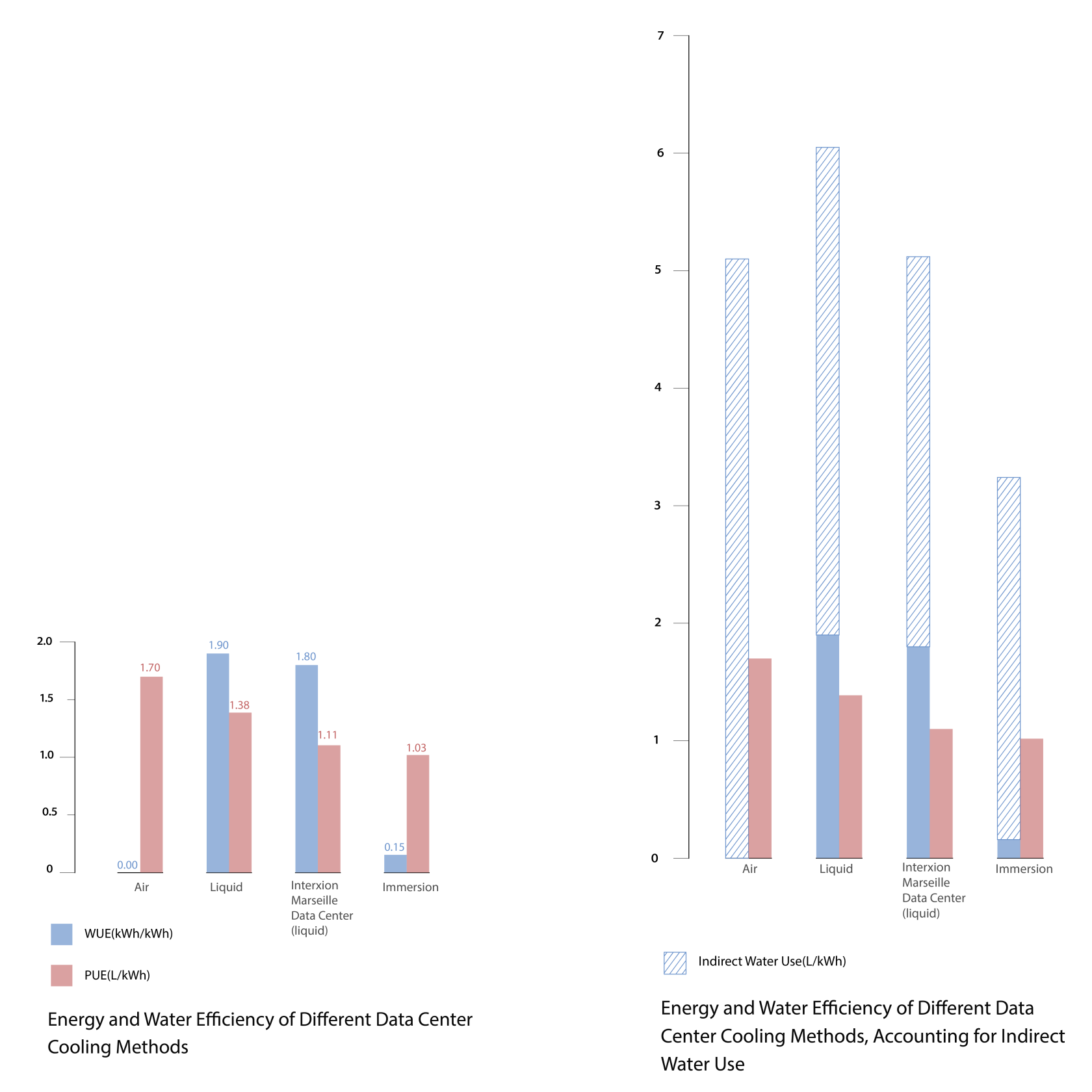
[Power Usage Effectiveness](https://hydraulogistics.at/link/16#bkmrk-pue) (PUE) = [Facility power](https://hydraulogistics.at/link/16#bkmrk-facility-power) (kWh)/[IT equipment power](https://hydraulogistics.at/link/16#bkmrk-it-equipment-power) (kWh)
[Water Usage Effectiveness](https://hydraulogistics.at/link/16#bkmrk-wue) (WUE) = Water usage (L)/[IT equipment power](https://hydraulogistics.at/link/16#bkmrk-it-equipment-power) (kWh)
Power Usage Effectiveness (PUE) and Water Usage Effectiveness (WUE) are ratios used to describe how efficiently data centers use energy and water. [PUE](https://hydraulogistics.at/link/16#bkmrk-pue) is calculated by dividing a data center’s total facility power by its required IT equipment power, which means that a PUE of 1.0 represents maximum efficiency, with 100% of the power used by the data center used for IT equipment and 0% for cooling and support systems. A higher PUE represents a higher proportion of the data center’s total energy consumption used for cooling and support systems.
[WUE](https://hydraulogistics.at/link/16#bkmrk-wue) is calculated by dividing a data center’s total water consumption by its required IT equipment power. A PUE of 1.0 represents a data center that uses one liter of water for every [kWh](https://hydraulogistics.at/link/16#bkmrk-kwh) of power its IT equipment uses, so a higher PUE signifies higher water consumption relative to computational power.
However, WUE does not account for water consumed throughout the process of producing the energy supplied to the data center. Fossil fuel energy production uses about 3 liters of water for each kWh of electricity produced, so by multiplying total facility power by 3, we can visualize the [indirect water use](https://hydraulogistics.at/link/16#bkmrk-indirect-water-use) relative to computational power for each data center cooling type.
# Trends in Data Center Efficiency
[![trajectory map [Converted].png](https://hydraulogistics.at/uploads/images/gallery/2025-09/scaled-1680-/trajectory-map-converted.png)](https://hydraulogistics.at/uploads/images/gallery/2025-09/scaled-1680-/trajectory-map-converted.png)
Recent years have witnessed a shift in the U.S. data center size, with the top panel showing how the percentage of servers housed in [hyperscale ](https://hydraulogistics.at/link/16#bkmrk-hyperscale-data-cent)and large [colocation](https://hydraulogistics.at/link/16#bkmrk-colocation-center) centers has grown steadily since 2014, while small/medium colocation facilities have remained relatively stable.
The middle panel illustrates the corresponding annual average [PUE](https://hydraulogistics.at/link/16#bkmrk-pue). As [hyperscale](https://hydraulogistics.at/link/16#bkmrk-hyperscale-data-cent) and colocation sites expanded, [PUE ](https://hydraulogistics.at/link/16#bkmrk-pue)declined from 1.6 in 2014 to just above 1.4 by 2023. This indicates that facilities are using less overhead energy per unit of IT load, which is more efficient. The shaded trajectory area suggests future projections, with [hyperscale ](https://hydraulogistics.at/link/16#bkmrk-hyperscale-data-cent)operators pushing [PUE](https://hydraulogistics.at/link/16#bkmrk-pue) closer to 1.2 or lower in coming years.
The bottom panel highlights the annual average [WUE](https://hydraulogistics.at/link/16#bkmrk-wue). While energy efficiency has improved, [WUE](https://hydraulogistics.at/link/16#bkmrk-wue) has gradually risen from 0.36 L/kWh in 2014 to 0.38 L/kWh in 2023. This reflects the trade-off: [hyperscale ](https://hydraulogistics.at/link/16#bkmrk-hyperscale-data-cent)and colocation sites often rely on evaporative cooling methods (cooling towers, adiabatic systems) that use water more intensively. In effect, operators are substituting water resources to reduce electricity demand, achieving lower [PUE](https://hydraulogistics.at/link/16#bkmrk-pue) but at the expense of higher water consumption.
As the share of [hyperscale ](https://hydraulogistics.at/link/16#bkmrk-hyperscale-data-cent)and large colocation data centers increases, [PUE](https://hydraulogistics.at/link/16#bkmrk-pue) improves while [WUE](https://hydraulogistics.at/link/16#bkmrk-wue) worsens. This indicates a clear inverse correlation: efficiency gains in electricity use are being achieved at the cost of higher water consumption. Looking ahead, the dotted trajectory line indicates that this trend is expected to continue. [Hyperscale ](https://hydraulogistics.at/link/16#bkmrk-hyperscale-data-cent)dominance will likely push [PUE](https://hydraulogistics.at/link/16#bkmrk-pue) further down, but [WUE](https://hydraulogistics.at/link/16#bkmrk-wue) will increase.
# Data Centers in Hot, Dry Climates
[](https://hydraulogistics.at/uploads/images/gallery/2025-09/scaled-1680-/drought-together.png)
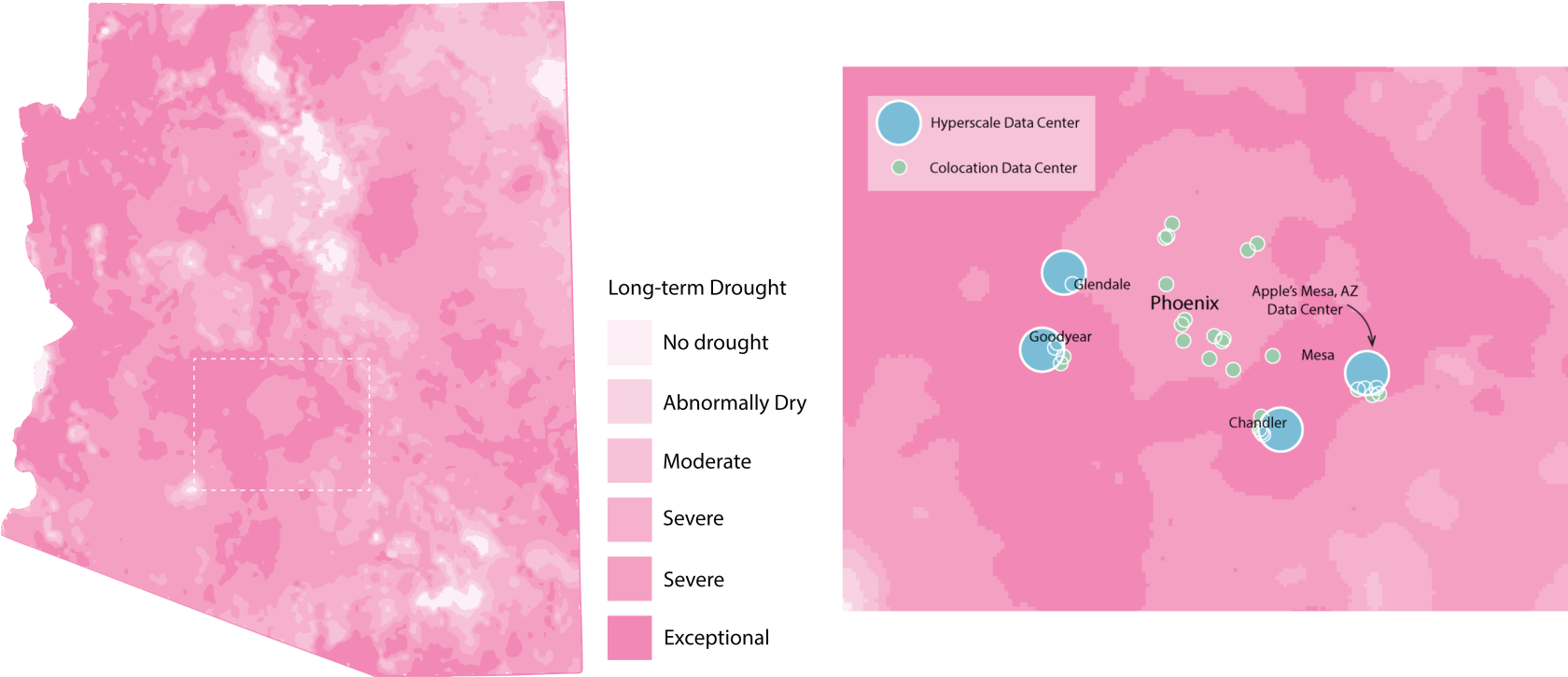
In hot, dry climates, the high water demand from data centers can put immense pressure on the local water supply, exacerbating the effects of drought conditions. Because [data centers mostly use potable water](https://hydraulogistics.at/books/chilled-infrastructures/page/visualizing-water-consumption-non-potable-vs-potable "Visualizing Water Consumption: Non-potable vs Potable"), this puts them in direct competition with local communities for drinking water. Nonetheless, major tech companies continue to plan, build, and operate [hyperscale](https://hydraulogistics.at/link/16#bkmrk-hyperscale-data-cent) data centers in hot, dry areas, with seemingly little regard for their impact on residents and the local environment. Locations for data centers generally depend on factors like proximity to customers and infrastructure, land and electricity prices, and tax incentives, and many data center companies are attracted to water-scarce regions in the western United States like Arizona due to the availability of solar and wind energy, despite the lack of water. In fact, an estimated one-fifth of data centers, mostly in the West, source their water from moderately to highly stressed watersheds.
For example, there are several hyperscale data centers in the Phoenix metropolitan area, where water has to be supplied from over 200 miles away due to long-term drought. Despite this, Apple's data center in [Mesa, Arizona](https://hydraulogistics.at/books/chilled-infrastructures/page/mesa-arizona "Mesa, Arizona") uses [evaporative cooling](https://hydraulogistics.at/link/16#bkmrk-evaporative-cooling) (which is associated with high water consumption) because of the high price of energy relative to water.
# Data Centers in Coastal Areas
[](https://hydraulogistics.at/uploads/images/gallery/2025-09/scaled-1680-/finland.webp)
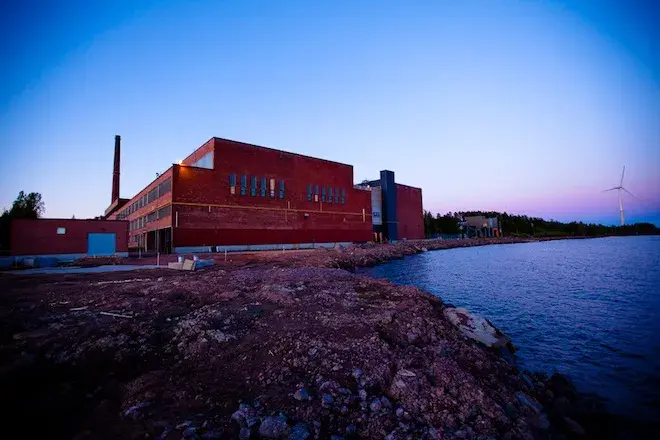
**Image: A Google data center in Finland that utilizes seawater cooling**
Coastal areas may appear to have an abundance of water, but this does not mean they are unaffected by the massive water demands of data centers. Some coastal data centers use seawater for cooling, which reduces consumption of freshwater and competition with local communities for potable water. However, seawater cooling still imposes negative environmental consequences, like the degradation of coastal ecosystems due to development in close proximity to the coast and disruption of marine life due to thermal pollution from discharged warm water.
Further, since seawater cooling systems are generally much more expensive and more difficult to implement, [most data centers require potable water for cooling](https://hydraulogistics.at/books/chilled-infrastructures/page/visualizing-water-consumption-non-potable-vs-potable "Visualizing Water Consumption: Non-potable vs Potable"), meaning they instead compete with residents for freshwater from sources like surface water and underground aquifers, contributing to water scarcity. In the long term, over-pumping from groundwater sources can cause issues like [subsidence](https://hydraulogistics.at/link/16#bkmrk-subsidence) and seawater intrusion in some coastal areas, including the Gulf Coast.
Even in areas with extensive freshwater resources, water is never as abundant as it seems. For example, in the [Great Lakes region](https://hydraulogistics.at/books/chilled-infrastructures/page/chicago-illinois "Chicago, Illinois"), the rapidly growing quantity of data centers that source their water from the lakes poses a threat to the more than 40 million people whose drinking water comes from the same source. The Great Lakes hold about 20% of the planet's surface freshwater, and seem almost inextinguishable, but with a replenishing rate of only about 1% of their total volume per year, the lakes are at risk of depletion over time by the billions of gallons of water annually demanded by data centers.
# Case Studies
# Marseille, France
[](https://hydraulogistics.at/uploads/images/gallery/2025-09/scaled-1680-/marseille-cooling.png)
In Marseille, France, a European data center company called Interxion uses a form of liquid-based [free cooling](https://hydraulogistics.at/books/chilled-infrastructures/page/free-cooling "Free Cooling") to decrease the energy required to cool its data centers. The facilities pipe water from 'La Galierie de la Mer,' a tunnel that runs from inland mining towns into the Mediterranean Sea near Marseille. The tunnel, which was built from 1885 to 1907 to pump wastewater from mining, carries water that naturally maintains a temperature of around 15C year-round. Although the water still needs to be filtered before it can be used for cooling the data centers, its naturally cool temperature eliminates the need for the energy-intensive process of chilling the water.
Interxion estimates that this method will save up to 18,400,000 kWh per year, or the equivalent of 795 tons of CO2, improving the Marseille data center's [power usage effectiveness](https://hydraulogistics.at/link/16#bkmrk-pue) to [1.11](https://hydraulogistics.at/books/chilled-infrastructures/page/comparing-impacts-by-cooling-type "Comparing Impacts by Cooling Type"), compared to the average PUE of [1.38](https://hydraulogistics.at/books/chilled-infrastructures/page/comparing-impacts-by-cooling-type "Comparing Impacts by Cooling Type") for traditional liquid cooling data centers. The company is also exploring the possibility of feeding the hot water output into the local urban heating network so it can be used to heat homes and offices. By repurposing what is essentially considered wastewater instead of [competing for potable water](https://hydraulogistics.at/books/chilled-infrastructures/page/visualizing-water-consumption-non-potable-vs-potable "Visualizing Water Consumption: Non-potable vs Potable"), [minimizing energy consumption](https://hydraulogistics.at/books/chilled-infrastructures/page/comparing-impacts-by-cooling-type "Comparing Impacts by Cooling Type") through free cooling, and exploring ways to benefit the local community through [heat export](https://hydraulogistics.at/link/16#bkmrk-heat-export), Interxion's Marseille data centers represent an attempt to create more responsible, harmonious data infrastructure.
# Mesa, Arizona
[](https://hydraulogistics.at/uploads/images/gallery/2025-09/scaled-1680-/mesa.webp)
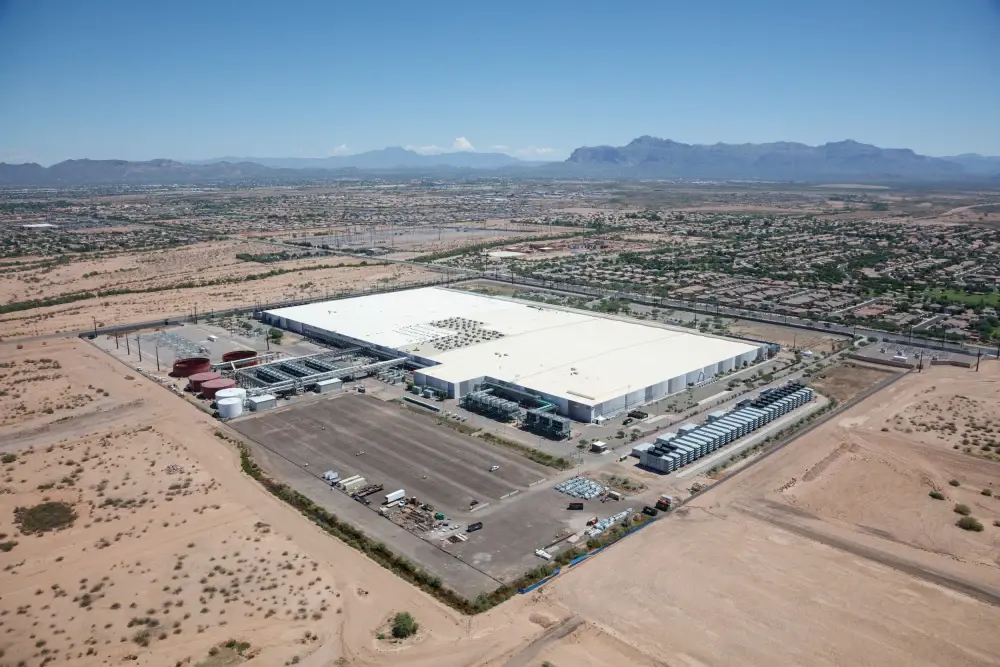
**Image:* *A**pple's data center in Mesa, Arizona**
In 2021, the City Council of Mesa, Arizona approved the construction of a new [hyperscale](https://hydraulogistics.at/link/16#bkmrk-hyperscale-data-cent) data center that would require 1.25 million gallons of water per day, exacerbating the concerns of Mesa residents growing increasingly frustrated by the exorbitant water use of hyperscale data centers in their already drought-stricken community.
Mesa, and the Phoenix metropolitan area as a whole, has been in a state of long-term drought since the 1990s, and has most of its water supplied from over 200 miles away through a canal pumping system. Because [data centers mostly use potable water](https://hydraulogistics.at/books/chilled-infrastructures/page/visualizing-water-consumption-non-potable-vs-potable "Visualizing Water Consumption: Non-potable vs Potable"), they are in direct competition with local communities for drinking water. Despite this, most data centers, including Apple's data center in Mesa, use water-intensive cooling methods like [evaporative cooling](https://hydraulogistics.at/link/16#bkmrk-evaporative-cooling) because of the higher price of energy relative to water.
[](https://hydraulogistics.at/uploads/images/gallery/2025-09/scaled-1680-/drought-together.png)
Apple's data center in Mesa is just one of many data centers in the drought-stricken Phoenix metropolitan area. Locations for data centers generally depend on factors like proximity to customers and infrastructure, land and electricity prices, and tax incentives, and many data center companies are attracted to [water-scarce regions](https://hydraulogistics.at/books/chilled-infrastructures/page/data-centers-in-hot-dry-climates "Data Centers in Hot, Dry Climates") in the western United States like Arizona due to the availability of solar and wind energy, despite the lack of water. In fact, an estimated one-fifth of data centers, mostly in the West, source their water from moderately to highly stressed watersheds.
# Chicago, Illinois
[](https://hydraulogistics.at/uploads/images/gallery/2025-09/scaled-1680-/mckinley-park-data-center.webp)
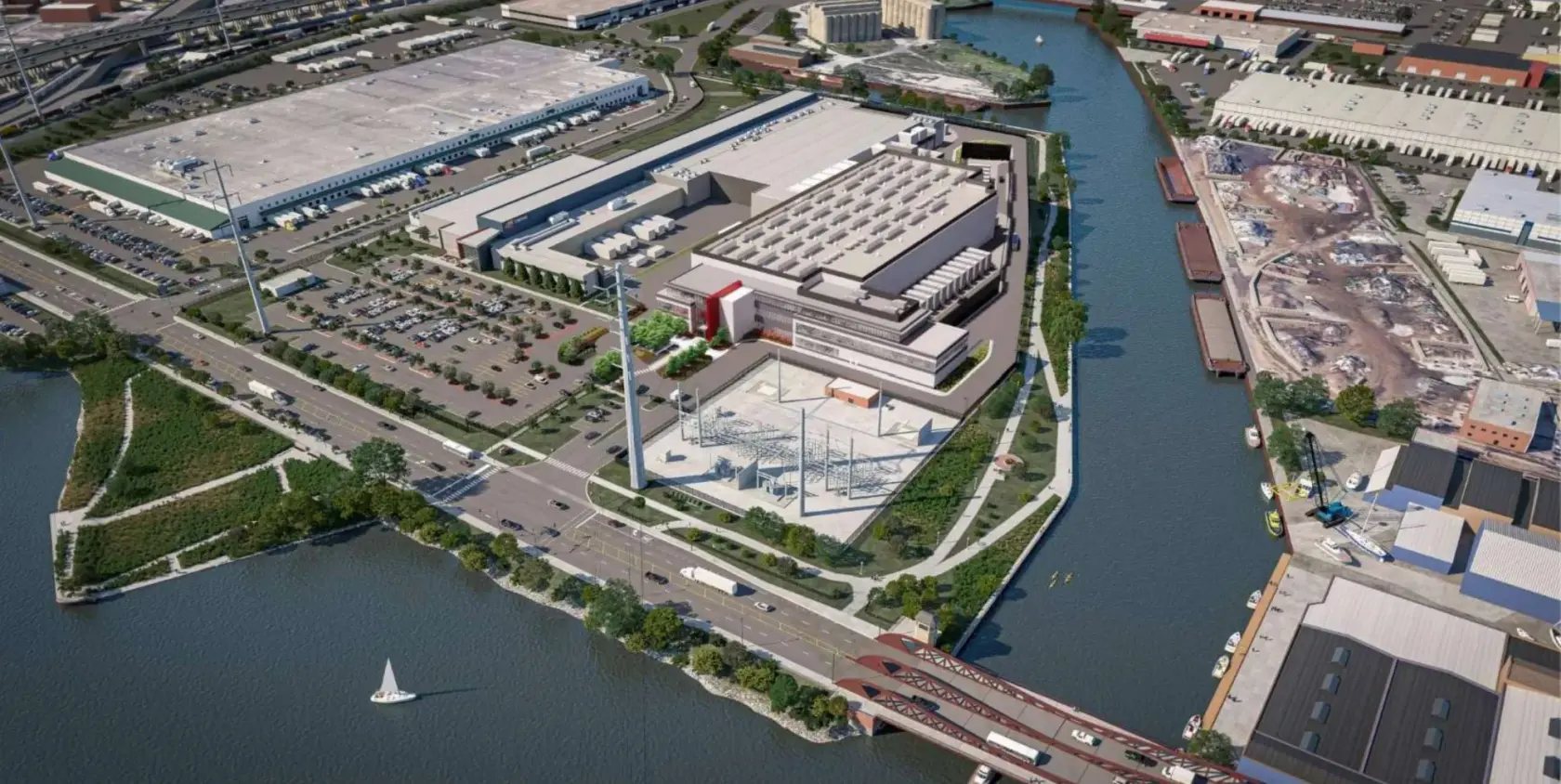
**Image:* *QTS is seeking to build a second data center at the property located at 2800 S. Ashland Ave. in McKinley Park.* *(By Lake Michigan)**
Chicago’s proximity to Lake Michigan and the Great Lakes basin makes it appear water-abundant, but new pressures from data centers powering AI have raised concerns about the long-term sustainability of these resources. The Great Lakes hold about 20% of the planet’s surface freshwater and supply drinking water to more than 40 million people in the region. Yet, they are a finite resource, replenished at a rate of only about 1% of their total volume per year.
According to the Alliance for the Great Lakes, data centers that support AI workloads can consume more than 365 million gallons of water annually, equivalent to the usage of 12,000 American households. Illinois already hosts over 187 operating data centers, and industry expansion is accelerating. Most of these facilities use evaporative cooling, in which more than half of the intake water is lost as vapor. This consumptive use represents a permanent removal from the water cycle, making it particularly concerning in a region whose lakes and aquifers replenish only slowly.
Beyond physical depletion, the lack of transparency reinforces the problem. Because many data centers are tied into municipal water systems, there is no direct requirement for companies to disclose water usage. Therefore, this creates what policy experts describe as a 'black box' around actual consumption, leaving authorities as well as the local communities with little oversight.
# Appendix
# Glossary
##### **acre-foot**
A unit of volume used to measure water; the amount of water needed to cover one acre of land (43,560 square feet) to a depth of one foot. One acre-foot is equivalent to about 1,233 m³.
##### [air cooling](https://hydraulogistics.at/books/chilled-infrastructures/page/air-cooling)
A data center cooling method that uses air conditioning systems to circulate cool air over hardware to dissipate heat.
##### **chiller**
A machine that removes heat from a liquid coolant through vapor-compression, adsorption refrigeration, or absorption refrigeration cycles.
##### **closed-loop system**
A type of cooling system that recirculates the coolant, reducing water use and contamination risk.
##### **colocation center**
Sometimes shortened to colo, a type of data center that rents out equipment, space, and bandwidth to retail customers, as opposed to single-tenant [hyperscale data centers](https://hydraulogistics.at/link/16#bkmrk-hyperscale-data-cent).
##### **cooling tower**
A device that rejects heat to the atmosphere by cooling a coolant stream (usually water) to a lower temperature, using either evaporation or air to cool the fluid.
##### **CRAH**
Computer Room Air Handler; an HVAC unit that provides precise cooling and humidity control for data centers and server rooms by circulating cold air, often through connection to an external chilling system.
##### **dielectric fluid**
A non-conductive liquid with high resistance to electric current, like synthetic hydrocarbons, esters, and fluorochemicals, often used for [immersion cooling](https://hydraulogistics.at/books/chilled-infrastructures/page/immersion-cooling "Immersion Cooling").
##### [evaporative cooling](https://hydraulogistics.at/link/19#bkmrk-one-type-of-liquid-c)
A data center cooling method that passes hot air over a water-saturated pad or through a heat exchanger using a cooling tower, causing water to evaporate and drawing heat from the air to cool the data center.
##### **facility power**
The total amount of electricity required by a given data center to run all of its equipment, including IT infrastructure and support systems like cooling and lighting; typically measured in [kWh](#bkmrk-kwh "kWh"); used to calculate [power usage effectiveness](https://hydraulogistics.at/link/16#bkmrk-pue).
##### [free cooling](https://hydraulogistics.at/books/chilled-infrastructures/page/free-cooling "Free Cooling")
A data center cooling method used in cold climates or locations with access to cold water sources that circulates naturally cool air or water, reducing reliance on mechanical refrigeration.
##### **heat export**
The process of capturing waste heat generated by IT equipment and repurposing it for external uses, like heating nearby buildings through a district heating network.
##### **hyperscale data center**
An extremely large facility that houses vast numbers of servers and storage systems, designed for extreme scalability and efficiency to meet the data demands of "hyperscale" businesses like large cloud service providers and social media companies.
##### [immersion cooling](https://hydraulogistics.at/books/chilled-infrastructures/page/immersion-cooling)
A data center cooling method that submerges servers and IT equipment in a [dielectric fluid](https://hydraulogistics.at/link/16#bkmrk-dielectric-fluid) coolant to remove heat.
##### **indirect water use**
Water consumed throughout the entire life cycle of producing and supplying energy, like the water used as a coolant to condense steam in thermoelectric power plants.
##### **IT equipment power**
The amount of electricity consumed by a given data center to power only information technology infrastructure, like servers and storage systems, without including electricity required for support systems; typically measured in [kWh](#bkmrk-kwh "kWh"); used to calculate [power usage effectiveness](#bkmrk-pue) and [water usage effectiveness](#bkmrk-wue).
##### **kWh**
A unit of energy representing the amount of energy used by a 1,000-watt appliance running for one hour.
##### [liquid cooling](https://hydraulogistics.at/books/chilled-infrastructures/page/liquid-cooling)
A data center cooling method that uses water or dielectric fluid to absorb and dissipate heat and circulates cool fluid through a [CRAH](#bkmrk-crah) or directly through computing components.
##### **open-loop system**
A type of cooling system that uses water for only one cycle before discarding it, which is more cost-effective in most places based on water prices, increasing water use and contamination risk.
##### **PUE**
Power Usage Effectiveness, a ratio that describes how efficiently a data center uses energy by comparing energy use by computing and non-computing equipment, with a higher PUE representing a less efficient data center and a PUE of 1.0 representing maximum efficiency; calculated by dividing a given data center's [facility power](#bkmrk-facility-power "facility power") by its [IT equipment power](#bkmrk-it-equipment-power "IT equipment power"); measured in kWh/kWh.
##### **single-phase immersion cooling**
A form of [immersion cooling](https://hydraulogistics.at/books/chilled-infrastructures/page/immersion-cooling "Immersion Cooling") in which servers are submerged in a [dielectric fluid](#bkmrk-dielectric-fluid "dielectric fluid") that stays in liquid form, transferring heat to an external cooling loop.
##### **subsidence**
The sinking and compaction of the land surface due to soil collapse as groundwater is pumped out, often resulting in infrastructure damage, flooding, and potential saltwater contamination.
##### **two-phase immersion cooling**
A form of [immersion cooling](https://hydraulogistics.at/books/chilled-infrastructures/page/immersion-cooling "Immersion Cooling") in which servers are submerged in a low-boiling [dielectric fluid](#bkmrk-dielectric-fluid "dielectric fluid") that evaporates when heated and condenses on a cooled coil, creating a boil condense cycle for heat removal.
##### **WUE**
Water Usage Effectiveness; a ratio that describes how efficiently a data center uses water by comparing total water use to energy used by IT equipment, with a higher WUE representing a less water-efficient data center and a lower WUE representing a more water-efficient one; calculated by dividing a given data center's total water consumption in liters by its [IT equipment power](#bkmrk-it-equipment-power "IT equipment power"); measured in L/kWh.
# References
[https://blockclubchicago.org/2025/08/28/the-great-lakes-could-be-at-risk-due-to-data-centers-powering-ai-study-warns](https://blockclubchicago.org/2025/08/28/the-great-lakes-could-be-at-risk-due-to-data-centers-powering-ai-study-warns/?utm_source=chatgpt.com)
[https://www.datacenterdynamics.com/en/analysis/recycled-buildings](https://www.datacenterdynamics.com/en/analysis/recycled-buildings/?utm_source=chatgpt.com)
[https://www.apmresearchlab.org/10x/data-centers-resource?](https://www.apmresearchlab.org/10x/data-centers-resource?utm_source=chatgpt.com)
[https://www.datacenterknowledge.com/cooling/thames-water-considers-restricting-flow-to-london-data-centers](https://www.datacenterknowledge.com/cooling/thames-water-considers-restricting-flow-to-london-data-centers?utm_source=chatgpt.com)
[Engineers often need a lot of water to keep data centers cool | ASCE](https://www.asce.org/publications-and-news/civil-engineering-source/civil-engineering-magazine/issues/magazine-issue/article/2024/03/engineers-often-need-a-lot-of-water-to-keep-data-centers-cool)
[https://www.datacenterdynamics.com/en/news/aws-using-reclaimed-wastewater-for-data-center-cooling-at-20-locations/](https://www.datacenterdynamics.com/en/news/aws-using-reclaimed-wastewater-for-data-center-cooling-at-20-locations/)
[https://www.datacenterdynamics.com/en/analysis/keeping-your-cooling-water-clean/](https://www.datacenterdynamics.com/en/analysis/keeping-your-cooling-water-clean/)
[https://www.epa.gov/waterreuse/water-reuse-case-study-quincy-washington](https://www.epa.gov/waterreuse/water-reuse-case-study-quincy-washington)
[https://www.asce.org/publications-and-news/civil-engineering-source/civil-engineering-magazine/issues/magazine-issue/article/2024/03/engineers-often-need-a-lot-of-water-to-keep-data-centers-cool](https://www.asce.org/publications-and-news/civil-engineering-source/civil-engineering-magazine/issues/magazine-issue/article/2024/03/engineers-often-need-a-lot-of-water-to-keep-data-centers-cool)
[https://eu-mayors.ec.europa.eu/en/Stockholm-Heat-recovery-from-data-centres](https://eu-mayors.ec.europa.eu/en/Stockholm-Heat-recovery-from-data-centres?utm_source=chatgpt.com)
[2024 United States Data Center Energy Usage Report](https://eta-publications.lbl.gov/sites/default/files/2024-12/lbnl-2024-united-states-data-center-energy-usage-report.pdf?utm_medium=email&utm_source=chatgpt.com)
[https://www.datacenterdynamics.com/en/news/googles-finland-data-center-pioneers-new-seawater-cooling/](https://www.datacenterdynamics.com/en/news/googles-finland-data-center-pioneers-new-seawater-cooling/)
[https://mepacademy.com/data-center-hvac-systems/](https://mepacademy.com/data-center-hvac-systems/)
[https://www.energy.gov/femp/cooling-water-efficiency-opportunities-federal-data-centers](https://www.energy.gov/femp/cooling-water-efficiency-opportunities-federal-data-centers)
[https://www.grcooling.com/blog/upgrading-an-air-cooled-data-center-to-immersion-cooling/](https://www.grcooling.com/blog/upgrading-an-air-cooled-data-center-to-immersion-cooling/)
[https://www.datacenterdynamics.com/en/analysis/natures-cool-enough/](https://www.datacenterdynamics.com/en/analysis/natures-cool-enough/)
[https://www.datacenterdynamics.com/en/news/interxion-switches-on-river-cooling-at-marseille-data-centers/](https://www.datacenterdynamics.com/en/news/interxion-switches-on-river-cooling-at-marseille-data-centers/)
[https://www.boydcorp.com/blog/energy-consumption-in-data-centers-air-versus-liquid-cooling.htm](https://www.boydcorp.com/blog/energy-consumption-in-data-centers-air-versus-liquid-cooling.html)
[https://asmedigitalcollection.asme.org/InterPACK/proceedings/InterPACK2022/86557/V001T01A014/1153400](https://asmedigitalcollection.asme.org/InterPACK/proceedings/InterPACK2022/86557/V001T01A014/1153400)
[https://eta-publications.lbl.gov/sites/default/files/2024-12/lbnl-2024-united-states-data-center-energy-usage-report.pdf?utm\_medium=email&utm](https://eta-publications.lbl.gov/sites/default/files/2024-12/lbnl-2024-united-states-data-center-energy-usage-report.pdf?utm_medium=email&utm_source=chatgpt.com)
[https://visualizingenergy.org/what-methods-of-electricity-generation-use-the-most-water/](https://visualizingenergy.org/what-methods-of-electricity-generation-use-the-most-water/)
[https://www.nbcnews.com/tech/internet/drought-stricken-communities-push-back-against-data-centers-n1271344](https://www.nbcnews.com/tech/internet/drought-stricken-communities-push-back-against-data-centers-n1271344)
[https://thecurrentga.org/2025/08/26/data-centers-consume-massive-amounts-of-water-companies-rarely-tell-the-public-exactly-how-much/#:~:text=A%202024%20report%20from%20the,in%20a%20fast%2Dchanging%20industry](https://thecurrentga.org/2025/08/26/data-centers-consume-massive-amounts-of-water-companies-rarely-tell-the-public-exactly-how-much/#:~:text=A%202024%20report%20from%20the,in%20a%20fast%2Dchanging%20industry)
[https://sevenseaswater.com/data-center-water-usage/](https://sevenseaswater.com/data-center-water-usage/)