# Liquid Cooling
[](https://hydraulogistics.at/uploads/images/gallery/2025-09/scaled-1680-/liquid-cooling.png)
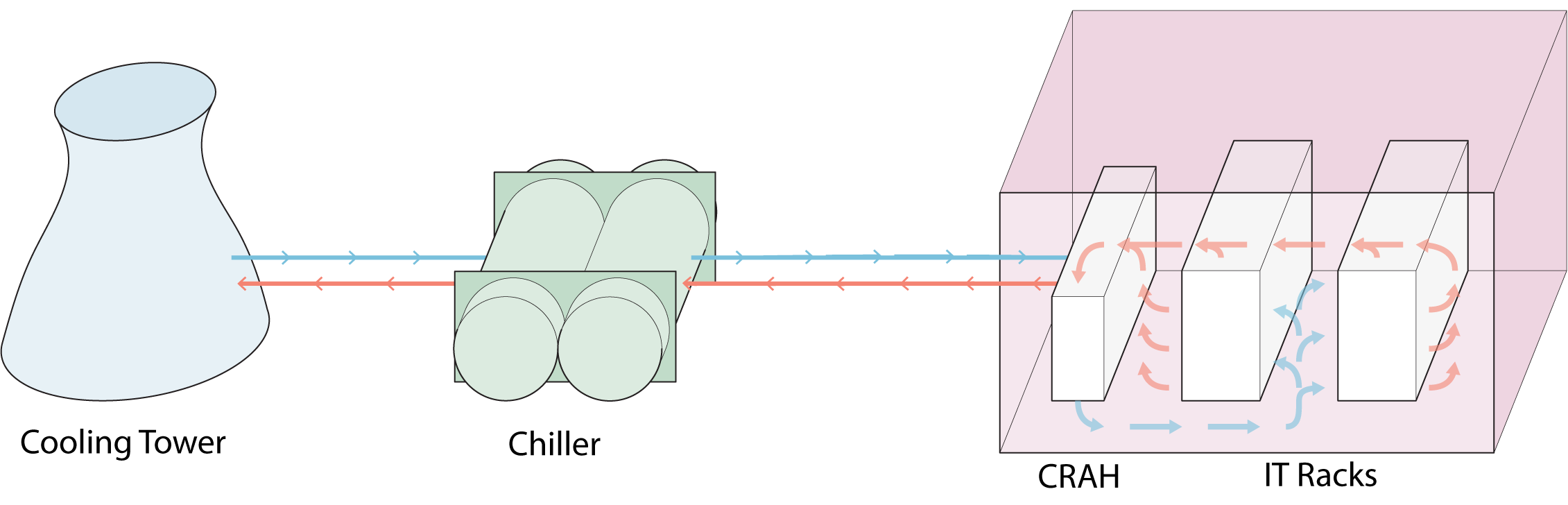
Liquid cooling is a data center cooling method that uses liquid coolants (often water) to absorb heat from computing equipment. This method can appear in a variety of ways.
One type of liquid cooling, illustrated above, is called [evaporative cooling](https://hydraulogistics.at/link/16#bkmrk-evaporative-cooling), and uses [cooling towers](https://hydraulogistics.at/link/16#bkmrk-cooling-tower) to draw hot air through water-saturated media, with the water's evaporation absorbing heat from the air. The cooling tower is used to cool the [chiller](https://hydraulogistics.at/link/16#bkmrk-chiller)'s condenser water, allowing the chiller to circulate colder water to the computer room, where it is either circulated directly through the IT racks or, in a hybridized system using [air cooling](https://hydraulogistics.at/books/chilled-infrastructures/page/air-cooling "Air Cooling"), supplied to the [CRAH](https://hydraulogistics.at/link/16#bkmrk-crah). Another variant of liquid cooling is [immersion cooling](https://hydraulogistics.at/books/chilled-infrastructures/page/immersion-cooling "Immersion Cooling"), in which servers and IT equipment are directly submerged in a [dielectric fluid](https://hydraulogistics.at/link/16#bkmrk-dielectric-fluid) coolant to remove heat.
In terms of liquid supply, liquid cooling can use either a [closed-loop](https://hydraulogistics.at/link/16#bkmrk-closed-loop-system) or an [open-loop](https://hydraulogistics.at/link/16#bkmrk-open-loop-system) system. Closed-loop systems are more expensive to implement, but recirculate the coolant to reduce water use and prevent contamination. Open-loop systems are more cost-effective, but use water only once before disposing of are more water-intensive and involve a higher risk of environmental contamination.
Liquid cooling (excluding the immersion cooling variant) is used by about 16% of data centers. Compared to air cooling, liquid cooling is more energy-efficient and is equipped to handle larger, higher-density servers.
On average, liquid-cooled data centers (excluding immersion cooling) have a [power usage effectiveness](https://hydraulogistics.at/link/16#bkmrk-pue) of [1.38](https://hydraulogistics.at/books/chilled-infrastructures/page/comparing-impacts-by-cooling-type "Comparing Impacts by Cooling Type"), and a relatively inefficient [water usage effectiveness](https://hydraulogistics.at/link/16#bkmrk-wue) of [1.90](https://hydraulogistics.at/books/chilled-infrastructures/page/comparing-impacts-by-cooling-type "Comparing Impacts by Cooling Type"), not considering their [indirect water use](https://hydraulogistics.at/link/16#bkmrk-indirect-water-use).
Depending on their location, some data centers can take advantage of existing water features to reduce energy consumption. For example, in [Marseille, France](https://hydraulogistics.at/books/chilled-infrastructures/page/marseille-france "Marseille, France"), Interxion uses a form of liquid-based [free cooling](https://hydraulogistics.at/books/chilled-infrastructures/page/free-cooling "Free Cooling"), sourcing water from a tunnel that carries flowing water at a natural, consistent temperature of 15C. Although the water still requires some filtration, the facilities bypass the need for extensive cooling processes, improving its [power usage effectiveness](https://hydraulogistics.at/link/16#bkmrk-pue) to [1.11](https://hydraulogistics.at/books/chilled-infrastructures/page/comparing-impacts-by-cooling-type "Comparing Impacts by Cooling Type").