Liquid Cooling
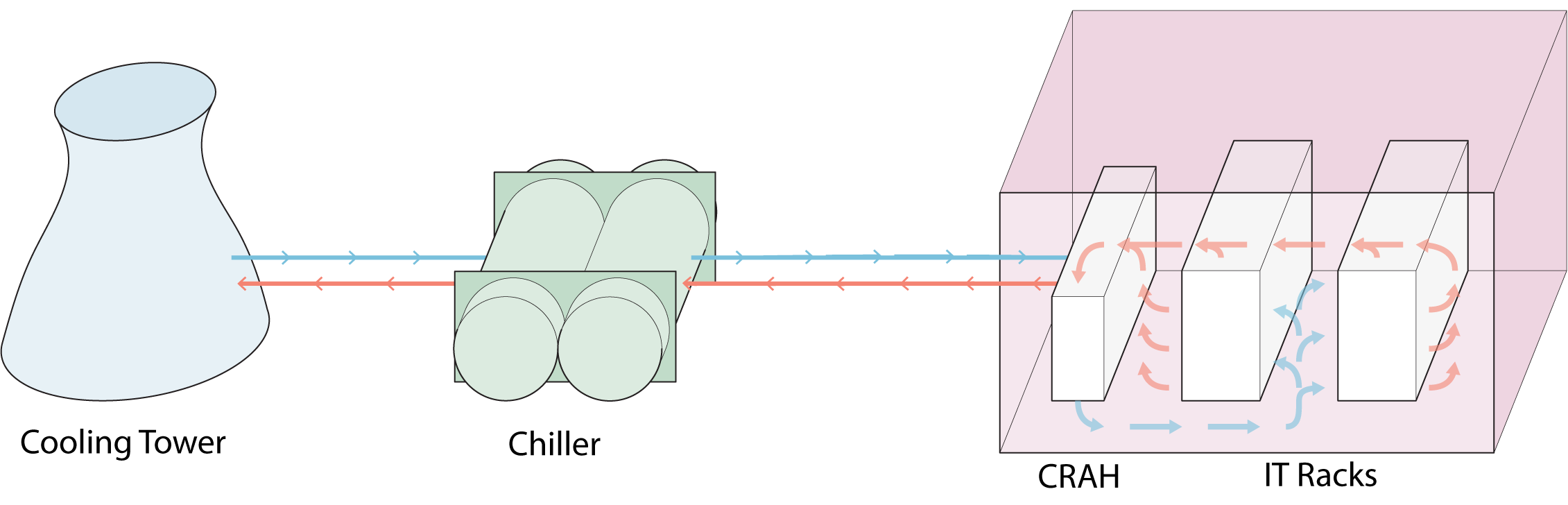
Liquid cooling is a data center cooling method that uses liquid coolants (often water) to absorb heat from computing equipment. This method can appear in a variety of ways.
One type of liquid cooling, illustrated above, is called evaporative cooling, and uses cooling towers to draw hot air through water-saturated media, with the water's evaporation absorbing heat from the air. The cooling tower is used to cool the chiller's condenser water, allowing the chiller to circulate colder water to the computer room, where it is either circulated directly through the IT racks or, in a hybridized system using air cooling, supplied to the CRAH. Another variant of liquid cooling is immersion cooling, in which servers and IT equipment are directly submerged in a dielectric fluid coolant to remove heat.
Liquid cooling (excluding the immersion cooling variant) is used by about 16% of data centers. Compared to air cooling, liquid cooling is more energy-efficient and is equipped to handle larger, higher-density servers.
On average, liquid-cooled data centers (excluding immersion cooling) have a power usage effectiveness of 1.38, and a relatively inefficient water usage effectiveness of 1.90, not considering their indirect water use.