Liquid Cooling
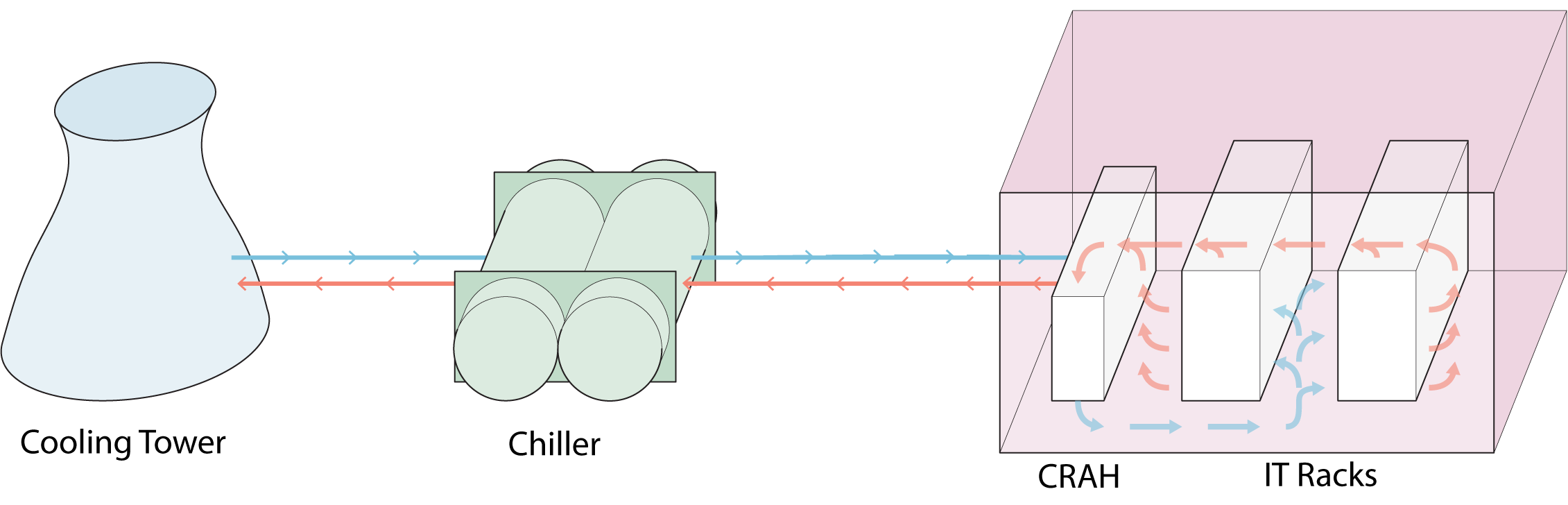
Liquid cooling is a data center cooling method that uses liquid coolants (often water) to absorb heat from computing equipment. This method can appear in severala variety of ways.
One type of liquid cooling, illustrated above, is called evaporative cooling, and uses cooling towers to draw hot air through water-saturated media, with the water's evaporation absorbing heat from the air. The cooling tower is used to cool the chiller's condenser water, allowing the chiller to circulate colder water to the computer room, where it is either circulated directly through the IT racks or, in a hybridized system using air cooling, supplied to the CRAH. orAnother circulatedvariant of liquid cooling is immersion cooling, in which servers and IT equipment are directly throughsubmerged thein ITa racks.dielectric fluid coolant to remove heat.
condenser water from the chiller's
Evaporative cooling works by using the natural principle of water evaporation to absorb heat and cool the air. Hot air is drawn through water-saturated media, where the water's evaporation absorbs heat from the air, thus lowering its temperature before it circulates through the data center to cool the servers. There are two main types: direct evaporative cooling (DEC), which cools the air directly by passing it through water-soaked pads, and indirect evaporative cooling (IEC), which uses a heat exchanger to transfer the cooling effect to a separate air stream without directly contacting the data center air.
fans and air conditioning units (often within the computer room in the form of CRAHs) to circulate cool air between IT racks, expelling the hot air from computing equipment.
Air-liquid hybrid cooling in data centers uses both air and liquid methods to manage heat, with liquid cooling handling high-heat components and air cooling managing less demanding areas or components. Liquid cooling uses(excluding cold plates on processors orthe immersion tanks to directly transfer heat to a coolant, which is then circulated to a chiller or dry cooler. The liquid is then cooled and recirculated, while air cooling, via units like CRAHs or rear-door heat exchangers, handles the broader server environment and smaller components. This combination provides efficient, flexible thermal management for high-density servers, optimizing energy and water usage.
Considered the most traditional cooling method, air coolingvariant) is used by approximatelyabout 80%16% of data centers. It is most suitable for smaller data centers, because it is sufficient for smaller heat loads while being cost-effective and easyCompared to implementair oncooling, a small scale. However, for larger data centers with a more significant heat load, airliquid cooling is insufficientmore energy-efficient and mustis be supplemented or hybridized with other methods like liquid cooling.
In cooler climates, some data centers can reduce energy consumption by circulating ambient cool airequipped to coolhandle equipmentlarger, (knownhigher-density as free cooling), bypassing the energy-intensive process of conditioning the air.servers.
On average, air-liquid-cooled data centers (excluding immersion cooling) have a relatively inefficient power usage effectiveness of 1.7038, butand a near-zerorelatively inefficient water usage sinceeffectiveness theyof do not directly use water for cooling,1.90, not considering their associated indirect water use.